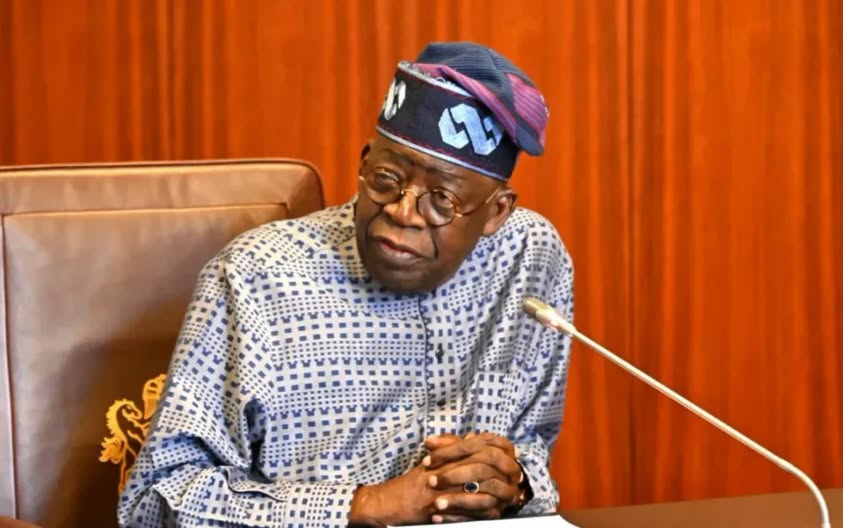
President Bola Tinubu has withdrawn his request for the Senate to approve external loans of $20.5 billion and €1.05 billion, replacing it with a fresh request for $7.7 billion in new external borrowing to part-finance the 2026 budget deficit. The new request was read by Senate President Godswill Akpabio during plenary in Abuja on Wednesday, 4 November 2026.
President Bola Tinubu has asked the Senate to approve a fresh external borrowing plan of $7.7 billion, dropping an earlier request for about $20.5 billion and €1.05 billion that he sent to the lawmakers only a week earlier. The change of plan was conveyed in an executive communication dated 26 October 2026, which Senate President Godswill Akpabio read to senators during plenary on Wednesday.
The exact figure in the new request is $7,707,404,882.49, which the Presidency put at about N10.79 trillion at the budget exchange rate of N1,400 to the United States dollar. The borrowing is meant to part-finance the deficit in the 2026 budget, and the President said it forms part of the borrowing already provided for in the 2026 Appropriation Act.
Akpabio told the chamber that the new letter effectively supersedes the earlier request, describing it as more explicit about where the money would come from and the conditions under which it would be raised. After reading the letter, he referred it to the Senate Committees on Local and Foreign Debts and Appropriations for detailed scrutiny, asking them to report back to plenary as soon as practicable.
The request Tinubu withdrew
The withdrawn request had been transmitted to the Senate only last Tuesday, 27 October 2026, under the 2026-2027 Supplementary External Borrowing Plan. In it, the President sought the National Assembly’s approval to process external loans worth $20,517,755,901 and €1,045,083,643.
The earlier proposal was therefore in the chamber for barely a week before it was pulled back. The Presidency has not given a separate reason for the change beyond what is contained in the new letter, which sets out the financing options in greater detail than the earlier submission did. The new request is smaller than the combined value of the withdrawn one, and it is framed as the external component of the borrowing plan already approved in the 2026 budget, rather than as a supplementary plan.
Where the $7.7 billion will come from
According to the President’s letter, the $7.7 billion will be raised through a combination of sources, pursued at the same time. They include Eurobond issuance, concessional and commercial facilities from multilateral and bilateral institutions, facilities from the International Monetary Fund, bridge financing, and direct borrowing from international financial institutions.
“The plan is to raise the new external borrowings of USD 7.7 billion. I wish to note that all the options will be pursued simultaneously considering the cost and relative benefits to the country and the time required to access the funds,” the letter read in part.
The President described Eurobond issuance as faster to conclude and able to raise larger amounts at relatively lower cost, according to reports of the letter’s contents. He sought authorisation for the Minister of Finance and the Debt Management Office to execute the borrowing.
The request was made under Sections 21(1) and 27(1) of the Debt Management Office (Establishment, etc.) Act, 2003, which require external loan terms and conditions to be presented to and approved by the National Assembly.
What the money is meant to fund
The President said the borrowing is intended to part-finance the 2026 budget deficit. The 2026 Appropriation Act authorised aggregate new borrowing of N29.2 trillion to partly finance a projected fiscal deficit of N31.4 trillion. Of that N29.2 trillion, N18.4 trillion is to be raised from domestic sources, while N10.79 trillion is the external component. The new $7.7 billion request is that external component.
The funds are earmarked for projects in defence and security, transportation, agriculture, power, education and healthcare, according to the letter. No project-by-project breakdown has been published, and the Senate committees are expected to examine the details as part of their scrutiny before the request returns to the floor for a decision.
What the Senate does next
The request now sits with the Senate Committee on Local and Foreign Debts and the Committee on Appropriations. The two committees are to examine the terms, the sources of the funds and the conditions attached to each option, and report back to the Senate as soon as practicable. The Senate has not fixed a date for a vote on the request.
The referral follows the same path as other borrowing requests. The committees can invite the Minister of Finance and the Director-General of the Debt Management Office to explain the plan, and they can recommend approval, approval with conditions, or rejection. Until their report is laid before the Senate, the $7.7 billion remains a request, not an approved loan, and no money can be drawn down under it.
The debt picture behind the request
The new borrowing request comes at a time when Nigeria’s public debt is already large. According to the Debt Management Office, Nigeria’s total public debt stood at N166.79 trillion, about $120.93 billion, as at 30 June 2026. That total comprised N91.59 trillion in domestic debt and N75.20 trillion in external debt.
Supporters of borrowing argue that the deficit must be financed somehow, and that external loans, particularly concessional facilities from multilateral lenders, can be cheaper than domestic borrowing. Critics argue that each new loan adds to a repayment burden that already takes a large share of government revenue, and that the value of borrowing depends on whether the money is spent on projects that grow the economy. The debate is a familiar one in the National Assembly, and it is expected to shape the committees’ examination of this request.
What it means for Enugu and Nsukka
The sectors listed for the borrowing include education, agriculture and power, three areas that matter directly to Enugu State and the Nsukka zone. The University of Nigeria, Nsukka, is one of the country’s largest federal universities, and Enugu State is largely agrarian, with farming as a mainstay for many households across Nsukka, Udenu, Igbo-Eze North, Igbo-Eze South, Uzo-Uwani and Igbo-Etiti local government areas.
On power, the timing is notable. The Transmission Company of Nigeria is carrying out maintenance at its Nsukka station from Thursday, 5 November to Tuesday, 10 November 2026, with planned daily interruptions between 9 a.m. and 5 p.m. for customers on the UNN, SUMAS and Orba 33kV feeders. The maintenance is a reminder of how much of the zone’s electricity infrastructure depends on federal transmission assets, and of why power is listed among the priority sectors for the proposed borrowing.
It is important to be clear about what the letter does and does not say. The President’s request does not allocate any specific sum to Enugu State or to any project in Nsukka. The sectors are national priorities, and the actual projects to be funded will be determined through the budget and the borrowing plan’s implementation. What the request does mean for the zone is that education, agriculture and power, the sectors most relevant to Nsukka’s daily life, are among the stated reasons for taking on the debt, and the Senate’s scrutiny will determine whether the borrowing goes ahead at all.
What to watch next
The next step is the report of the Senate committees. Nigerians watching the process will look for three things: whether the committees back the $7.7 billion figure or seek changes, what conditions they attach to the approval, and how quickly the report reaches the floor. The committees were asked to report back as soon as practicable, but no deadline has been made public.
The House of Representatives will also have a role in the process, as external borrowing requires the approval of the National Assembly. For now, the Senate’s examination is the live stage, and the withdrawn $20.5 billion request is no longer before the chamber. The question before the lawmakers is now a narrower one: whether to approve $7.7 billion in external borrowing, on the terms set out in the President’s letter, to part-finance a budget deficit that the 2026 Appropriation Act already provided for.